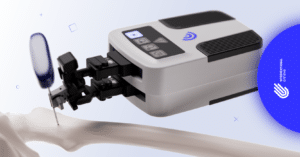
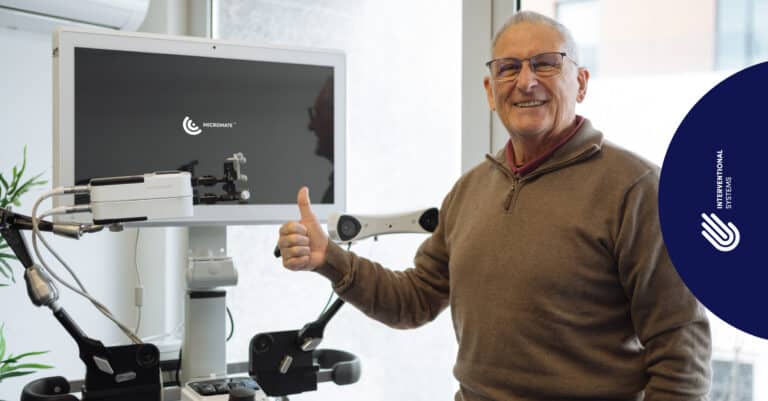
Carlos Tavares, 76, was one of the first patients to benefit from the robotic precision of Micromate™ in Portugal, at the Local Health Unit of Gaia and Espinho (ULS Gaia and Espinho). The procedure was led by Dr. Teresa Dionísio, Division Chief of Interventional Radiology.
Being selected for one of the first procedures was no coincidence. After doctors identified a lesion in his liver, Carlos had already undergone two biopsy attempts. “They just couldn’t get it. It was really hard to hit the right spot,” he recalls.
The depth of the lesion and its proximity to critical structures in the liver made the procedure particularly challenging. In the first attempt, the clinical team were unable to reach the target area. On his own initiative, Carlos sought an alternative at a private hospital, where he underwent another biopsy, but the sample collected was insufficient.
Back at ULS Gaia and Espinho, this time with the help of Micromate™, the clinical team finally obtained the long-awaited diagnosis. “It was a huge help for the physicians and, fundamentally, a small miracle,” he says.
Screen from Micromate’s planning and navigation software, MicroNav.
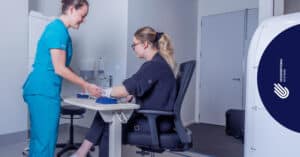
Dr. Dionísio and team performing the biopsy.
When asked how he felt about undergoing a robot-assisted biopsy, Carlos says he wasn’t exactly nervous, though he was a bit apprehensive. Still, he admits he had “hope” in the robot. “They told me they would have the machine and that they would likely succeed because there were areas that just weren’t humanly accessible,” he explains.
On that day, Dr. Teresa Dionísio’s team performed five procedures using Micromate™: two biopsies (liver and lung) and three liver thermal ablations. Despite being their first experience with the system, all cases were chosen for their complexity.
If he had to give advice to another patient hesitant about robotic procedures, Carlos is clear: “Don’t think twice—go for it. Go ahead because it’s a tool that helps medicine. Don’t be afraid. It won’t hurt you; it doesn’t bite.”
“Extremely grateful” to the clinical team for the opportunity, Carlos also emphasized the dedication of the healthcare professionals who cared for him.