Imagine a pain so sudden and intense it feels like an electric shock to the face. Now imagine it happening up to 100 times a day, triggered by something as ordinary as chewing, brushing your teeth, or a gust of cold air. This is the daily reality for patients living with trigeminal neuralgia, one of the most severe pain conditions known in medicine.
For many patients, years pass between the onset of symptoms and effective treatment. The good news is that for carefully selected cases, a minimally invasive, robotic-assisted procedure can offer lasting relief, often on an outpatient basis.
We sat down with Prof. Reto Bale, Deputy Director of the Department of Radiology and the Head of the Section of Interventional Oncology / Stereotaxy and Robotics at the Medical University of Innsbruck (Tirol Kliniken), to walk through the condition, the available treatments, and the role robotic precision plays in improving outcomes. At Innsbruck, that technology is Micromate.
What is trigeminal neuralgia?
Trigeminal neuralgia is a chronic pain condition affecting the trigeminal nerve, which carries sensation from the face to the brain. The condition produces sudden, severe attacks of shooting or electric shock-like pain, typically affecting one side of the face. These episodes can be triggered by the lightest touch or movement and may occur dozens of times a day.
There are three main forms. Classic trigeminal neuralgia is caused by a blood vessel pressing against the trigeminal nerve as it exits the brainstem. A second form occurs in patients with underlying conditions such as multiple sclerosis or tumors. A third, idiopathic form has no clearly identified cause.
Treatment options
The first line of treatment is medication. Drug therapy is effective for many patients initially, but over time, it may lose efficacy or produce pronounced side effects that reduce quality of life. When medication no longer provides adequate relief, two main interventional options are available.
The Jannetta procedure is a neurosurgical operation in which the skull is opened, and a small Teflon pad is placed between the compressing vessel and the nerve. It offers a lower recurrence rate and is typically preferred for younger patients who can tolerate a more invasive approach.
For older patients, those with multiple sclerosis as the underlying cause, or those for whom surgery carries too high a risk, thermocoagulation is the procedure of choice at Prof. Bale’s centre in Innsbruck.
How does robotic-assisted thermocoagulation work?
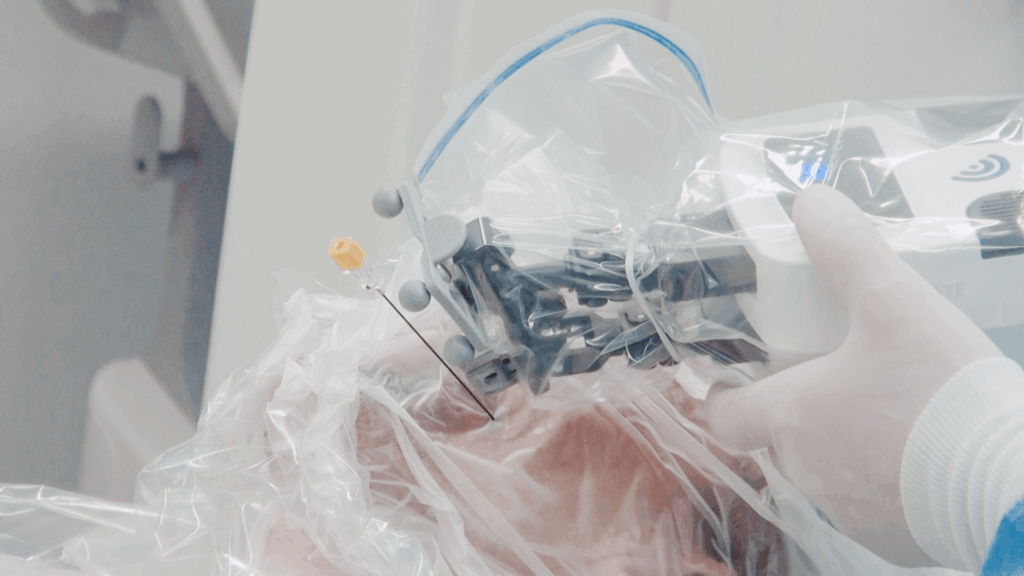
Thermocoagulation targets the Gasserian ganglion, the cluster of nerve cell bodies that carry pain signals from the trigeminal nerve. The procedure involves advancing a probe through the foramen ovale, a small natural opening at the base of the skull, approximately 6 by 3 millimetres in size. Once positioned correctly within the ganglion, the tip is heated to 73 degrees Celsius for one minute, selectively coagulating the nerve fibres responsible for the pain.
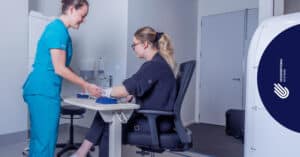
The patient can typically be discharged the same day or the following day. The procedure is performed under short intravenous anaesthesia for the coagulation step itself, while the patient remains awake for the targeting phase to allow real-time sensory feedback.
Why robotic assistance matters
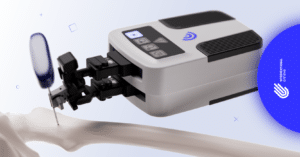
The critical challenge of this procedure lies in the precision it demands. The working path from the skin entry point near the corner of the mouth to the target inside the skull is roughly 10 centimetres long. The needle must pass through a small opening only millimetres across before reaching the correct location within the ganglion. Any deviation affects both the outcome and the risk profile.
“We have treated patients who had endured terrible pain for 20 years or more. With [Micromate], we can treat them with a small, highly precise procedure — and they have been pain-free since.”
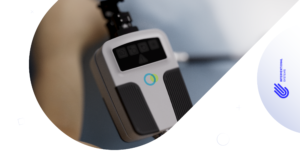
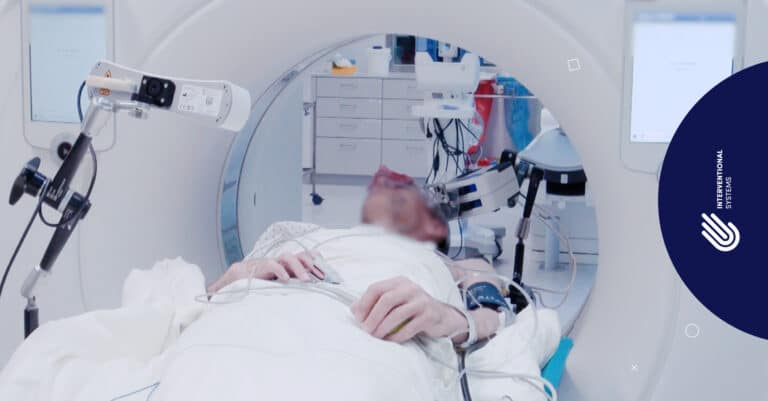
At Innsbruck, using Micromate has become standard for this procedure. After an initial CT scan, the trajectory is planned in software, defining the entry point and the target. The robot then positions the needle guide with a single click, leaving the clinician to simply advance the needle along the pre-planned path.
As Prof. Bale describes it, the robot reliably helps reach the foramen ovale on the first attempt, directly or at least at its edge.
Complications and considerations
The most common side effect of thermocoagulation is a sensation of numbness in the distribution of the treated nerve. This can be temporary or permanent, but most patients accept it readily compared to the pain they were experiencing beforehand. In rare cases, weakness of the chewing muscles or disturbance of the tear reflex may occur. The most serious complication, anaesthesia dolorosa, a form of chronic, constant pain, occurs in approximately 0.5% of cases and is largely avoided by carefully selecting patients who present with typical episodic pain rather than constant pain.
Recurrence rates for thermocoagulation are higher than for the Jannetta operation over the long term, which is why age and overall health remain key factors in treatment selection. For patients who are not surgical candidates, or where multiple sclerosis is the underlying cause, thermocoagulation is the intervention of choice.
A procedure made possible by Micromate
Prof. Bale describes robotic-assisted thermocoagulation as one of his favorite procedures, and it is easy to understand why. A condition that may have caused decades of suffering can, in many cases, be resolved in a single outpatient visit using a minimally invasive approach. The role of robotic assistance is not to change the clinical objective, but to make the execution of a technically demanding procedure more predictable, and the outcome more reliable.
Key Takeaways
- Trigeminal neuralgia causes severe, electric shock-like facial pain triggered by everyday actions
- When medication fails, two main options exist: the Jannetta surgical procedure, preferred for younger patients, and thermocoagulation, preferred for older patients and those with multiple sclerosis.
- Thermocoagulation targets the Gasserian ganglion through a small opening at the base of the skull, requiring a high degree of precision over a roughly 10 cm working path.
- Robotic assistance allows clinicians to reach the target on first attempt, reducing complexity and supporting a consistently safe, outpatient procedure.