Micromate™​ Case Report: Robotic-assisted, CT-guided Lung Biopsy

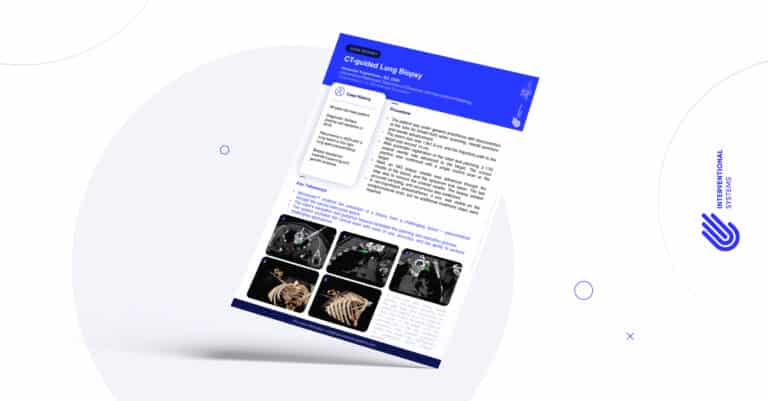
Case report of a Robotic-assisted, CT-guided Lung Biopsy

Micromate™ Case Report series presents real cases performed by the physicians currently using our full-fledged robotic platform for percutaneous procedures.

For this case report, we join Dr. Alexander Kupferthaler, Interventional Radiologist at Ordensklinikum Linz – Barmherzige Schwestern, for a CT-guided lung biopsy.

Clinical Context

The patient was a 58-year-old male diagnosed with solitary plasma cell myeloma in 2018, with recurrence in 2023 with a lung lesion in the right lung apex paravertebral.

A biopsy was needed for treatment planning and genetic analysis.

Interventional Procedure

The patient was under general anesthesia with disconnection of the tube for breath-hold when scanning, needle puncture, and needle advancement.

The lesion size was 1.6×1.9 cm, and the trajectory path to the target was around 14 cm.

After automatic registration of the robot and planning, a 17G coaxial needle was advanced to the target. The correct position was confirmed with a single control scan at the target.

Next, an 18G biopsy needle was advanced through the middle of the lesion, and the specimen was taken. The last step was to remove the coaxial needle. The biopsy yielded accurate sampling, and recurrence was confirmed.

A non-significant pneumothorax, 5 mm, was visible on the postprocedural scan, but no additional treatment steps were required.

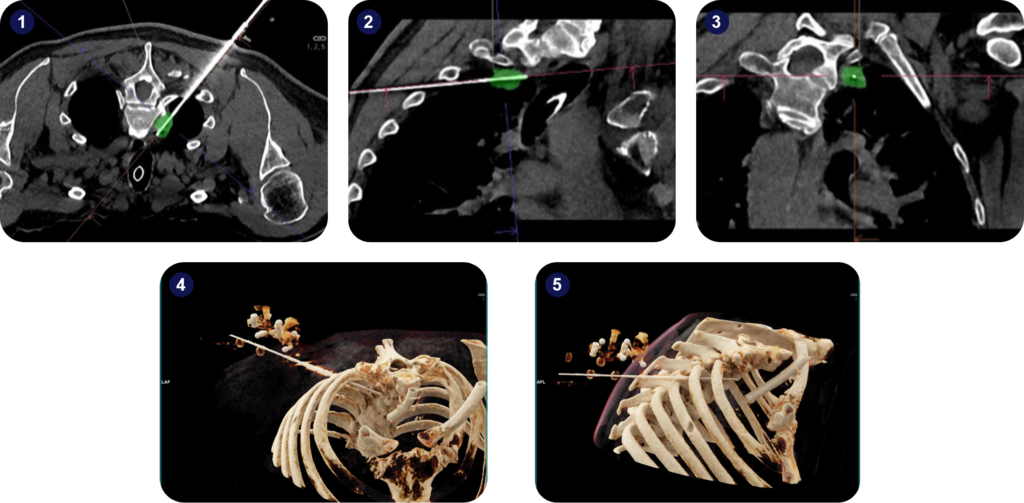
Biopsy needle insertion in the right lung apex paraventral during a CT-guided lung biopsy.
1) Axial view after biopsy needle insertion and tissue harvesting from the right lung apex paraventral (in green). 2) Sagittal view. 3) Trajectory view accentuating the needle target in the center of the lesion. 4-5) 3D reconstruction of the ribs, vertebrae structures, and inserted guidance needle from caudal view, highlighting the challenging double oblique approach.

Key Takeaways

Micromate™ enabled the extraction of a biopsy from a challenging lesion – paravertebral through the narrow intercostal space. The robot’s navigation and guidance features facilitated the planning and execution process.

The system provided the clinical team with ease of use, accuracy, and the ability to perform challenging approaches.

Download the case report here

More To Explore

Blog

Treating trigeminal neuralgia with robotic-assisted thermocoagulation

We sat down with Prof. Reto Bale, Deputy Director of the Department of Radiology and the Head of the Section of Interventional Oncology / Stereotaxy and Robotics at the Medical University of Innsbruck (Tirol Kliniken), to walk through the condition, the available treatments, and the role robotic precision plays in improving outcomes. At Innsbruck, that technology is Micromate.

Read More »
Blog

ATEC Spine Launches Valence, a Robotic Navigation System for Spine Surgery

ATEC Spine has commercially launched Valence, a fully integrated robotic and navigation system for spine surgery.¹ For us at Interventional Systems, this is a milestone worth acknowledging: Valence is built on the miniature robotic technology we developed, which found its way into the spine market through Fusion Robotics and eventually into ATEC’s hands via their acquisition of Accelus in 2023.

Read More »