Fifteen years ago, Interventional Systems (INS) was founded with a clear and ambitious vision: to make the precision and benefits of surgical robotics accessible to every patient and every hospital. Today, as we celebrate this milestone, we reflect on a journey driven by innovation, partnership, and an unwavering commitment to challenging the norm.
How it started
Our story began in 2010, born from a founder’s frustration with the status quo. Dr. Michael Vogele, a medical doctor and entrepreneur, alongside his partner Thomas Pfeifer, saw a critical gap in the surgical robotics market. After founding and successfully selling Medical Intelligence, a company that developed specialized radiotherapy couches for positioning patients during treatments, Dr. Vogele experimented with the surgical robots available at the time. He found them to be repurposed industrial arms: too large, too complex, and ill-suited for the delicate, needle-based procedures of micro-invasive surgery.
This dissatisfaction was the catalyst for Interventional Systems. Instead of adapting existing technology, we decided to build a solution from the ground up. The mission was to create a miniaturized, affordable, and easy-to-use robotic platform that could seamlessly integrate into any clinical workflow without compromising performance. This foundational principle of “value-based robotics” has guided every decision we’ve made since.
Our technology
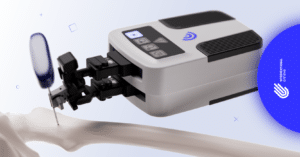
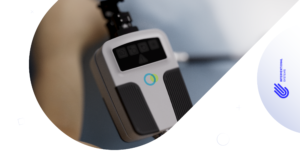
At the heart of our company is Micromate™, our flagship robotic platform and the world’s smallest head-to-toe medical robot for percutaneous procedures.
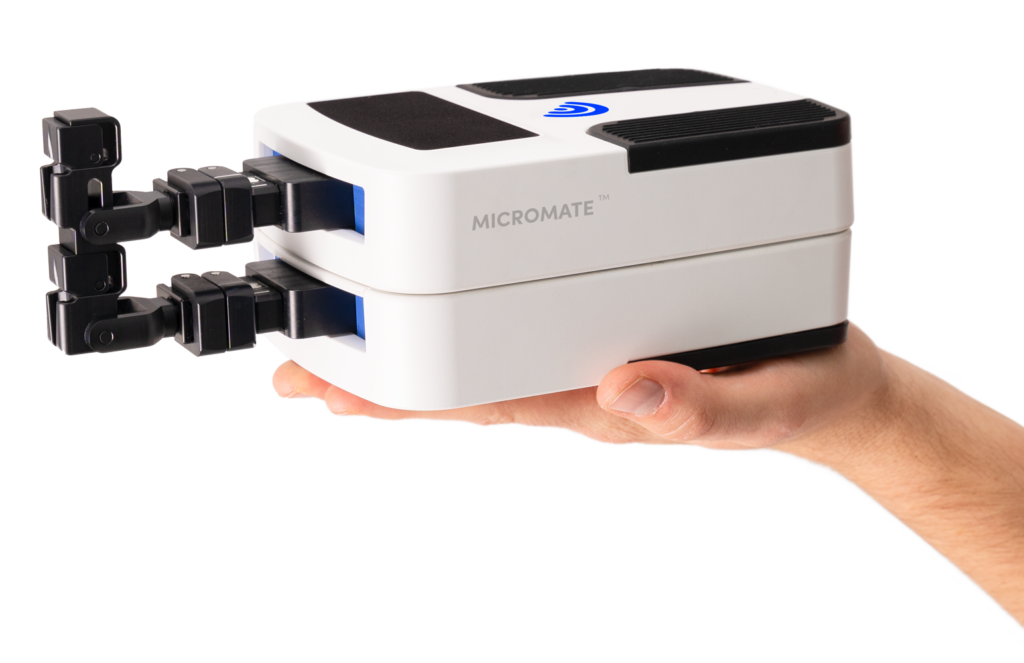
But Micromate™ is more than just a robot; it’s a full-fledged platform with a suite of supporting technologies, including positioning arms, table adapters, and baseplates that allow it to connect to any standard operating table. We also developed the iFIX patient positioning system to provide optimal patient stabilization during procedures.
Micromate™ stands out for its versatility and practicality. It’s instrument- and imaging-agnostic, meaning it offers a universal guidance solution compatible with any standard needle (from 8G to 21G) and integrates seamlessly with existing imaging modalities such as CT, Cone-Beam CT (CBCT), and Fluoroscopy.
The system delivers unmatched precision and efficiency, reducing complications and intervention times by half, thus decreasing radiation exposure. Setup is fast, and its intuitive interface seamlessly integrates with clinical workflows.
This remarkable versatility has allowed clinicians to employ Micromate™ for a wide array of cases from head to toe. Today, the technology supports clinical applications such as cranial neurosurgery, spinal interventions, but also the broad range of interventional radiology and oncology (ablations, biopsies, drainages, and embolizations). Further applications are in development or the pre-clinical concept phase.
Our global reach
From our headquarters in Kitzbühel, Austria, we have expanded our physical presence with offices in Germany, Portugal, and Serbia. But our true global reach is powered by our unique partnership-focused business model, with partners and distributors spread around the globe to bring our technology to more patients and hospitals.
INS robotic technology today is utilized in more than 18 reference sites for interventional procedures, including pioneering institutions such as St. Antonius Hospital in the Netherlands, the Innsbruck Medical University and Ordensklinikum Linz in Austria, and ATTIKON University Hospital in Greece. With our successfully growing OEM business and a broad range of clinical accessories, INS technologies are available in more than 30 countries across Europe, North America, and Asia.
We have established strategic partnerships to enhance our technology and expand its reach. This includes OEM agreements with the market leader in cranial neurosurgery and with ATEC Spine in the US, an IR/IO license with Minimax Medical in China, and a joint venture for spine surgery and sports medicine with Hicren, also based in China. Additionally, we collaborate with academic institutions and maintain a comprehensive Center of Excellence program to receive invaluable feedback, allowing us to continuously refine our products.
What’s next
The journey to today’s Micromate™ was patient and deliberate. Our first decade was dedicated to intensive research and development, ensuring we created the best possible product. This foundational period saw the launch of our first-generation robot, the iSYS1, and the creation of assistive technologies required for ultimate precision, including our versatile positioning arms and the iFIX patient positioning system. This period of intense R&D was also marked by a key partnership with a global market leader to develop instruments for navigated neurosurgery using the iSYS1 platform, an early validation of our technological vision.
Building on the success and learnings from iSYS1, we launched Micromate™ in Europe in 2020. This was followed by a series of rapid milestones: our first FDA 510(k) clearance for fluoroscopy-guided use in 2021, the launch of our innovative subscription model in 2022, and a second FDA clearance in October 2023 for CT-guided optical navigation, making Micromate™ the first needle-based robot in the world compatible with both imaging modalities.
But we are just getting started. Our roadmap includes enhancing the platform with more degrees of freedom and tool steerability, and expanding into new clinical fields, like we did with our endourology spin-off, LARC Robotics, proving that our technology is truly built for the future.
As we look to the next 15 years, our mission remains the same: to pioneer better patient outcomes by expanding access to micro-invasive interventions. We are incredibly proud of what our team and our partners have accomplished, and we are more excited than ever for the future of value-based robotics.