Innsbruck University Hospital has reported what it describes as a “worldwide unique procedure”: For the first time, a leak in the largest lymph vessel in a patient’s body has been treated with a micro-robotic-assisted puncture and vascular closure. The 63-year-old patient concerned was discharged 48 hours after the procedure last week.
The patient, who had most of his esophagus removed due to cancer, had a leak in the body’s largest lymph vessel (thoracic duct), that was causing around one liter of lymph fluid to flow into the chest cavity every day, which could be life-threatening in the long term.
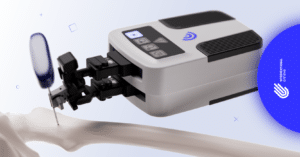
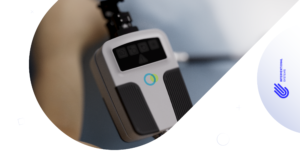
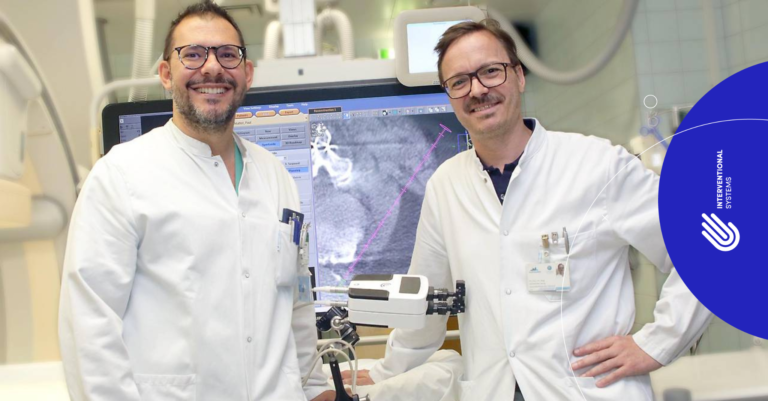
Instead of subjecting the patient to another major surgery, which may involve opening the chest to close the leak, two experts from the University Department of Radiology, Senior physician Alexander Loizides and managing senior physician Gerlig Widmann (pictured above with Micromate™), opted for a “globally unique, robot-assisted and minimally invasive approach”.
Successfully hitting a narrow target
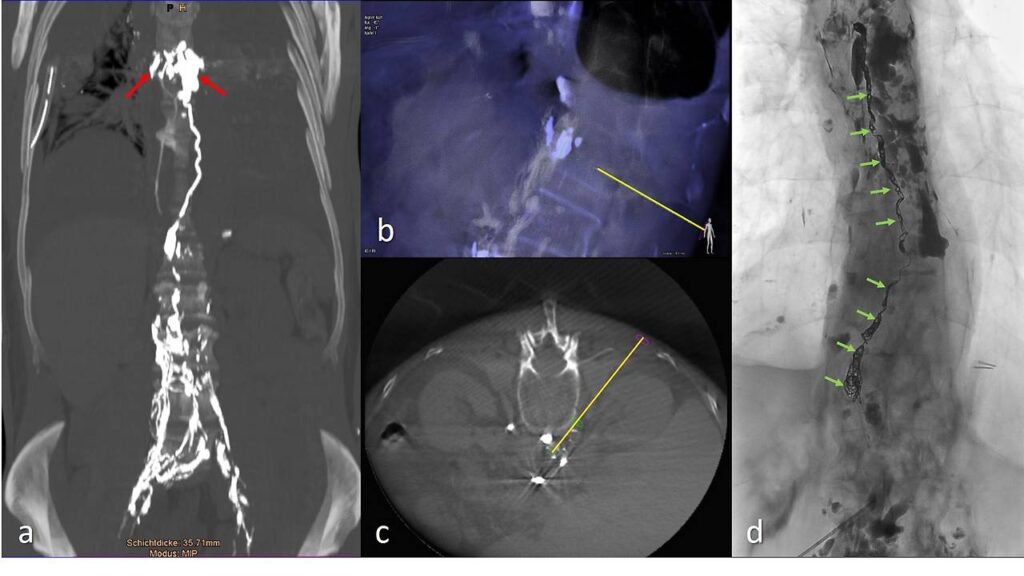
The physicians explained the process: “We first punctured a lymph node via both groins in order to apply contrast medium to the patient’s lymphatic system.”
This enabled them to visualize the lymphatic vessel and the leak using imaging. The patient was then turned onto their stomach and a long needle was advanced into the large lymph vessel using robotic-assisted navigation. “The challenge here is not to damage any sensitive vessels or organs on the way to the center of the body and to successfully hit the very narrow target,” explained Widmann. “And we used a microrobot for the first time in the world to help us with this task,” he added.
Leaking lymphatic vessel closed from the inside
A hollow guide catheter was then inserted via the needle and maneuvered into the leaking lymph vessel. Eleven “coils” (a type of metal spiral) were inserted and the lymph vessel was completely sealed from the inside. “It was very impressive to see how no new fluid came in within 24 hours, the patient was able to breathe normally again and was discharged after just 48 hours,” Widmann and Loizides were pleased to report.
This innovative approach could help to treat similar cases more efficiently and with less stress for patients in the future.
Source:
https://tirol.orf.at/stories/3263657/
https://science.apa.at/power-search/6116936515941068868